SEO vs GEO vs AEO Explained Simply: How to Win on Google and AI Overviews
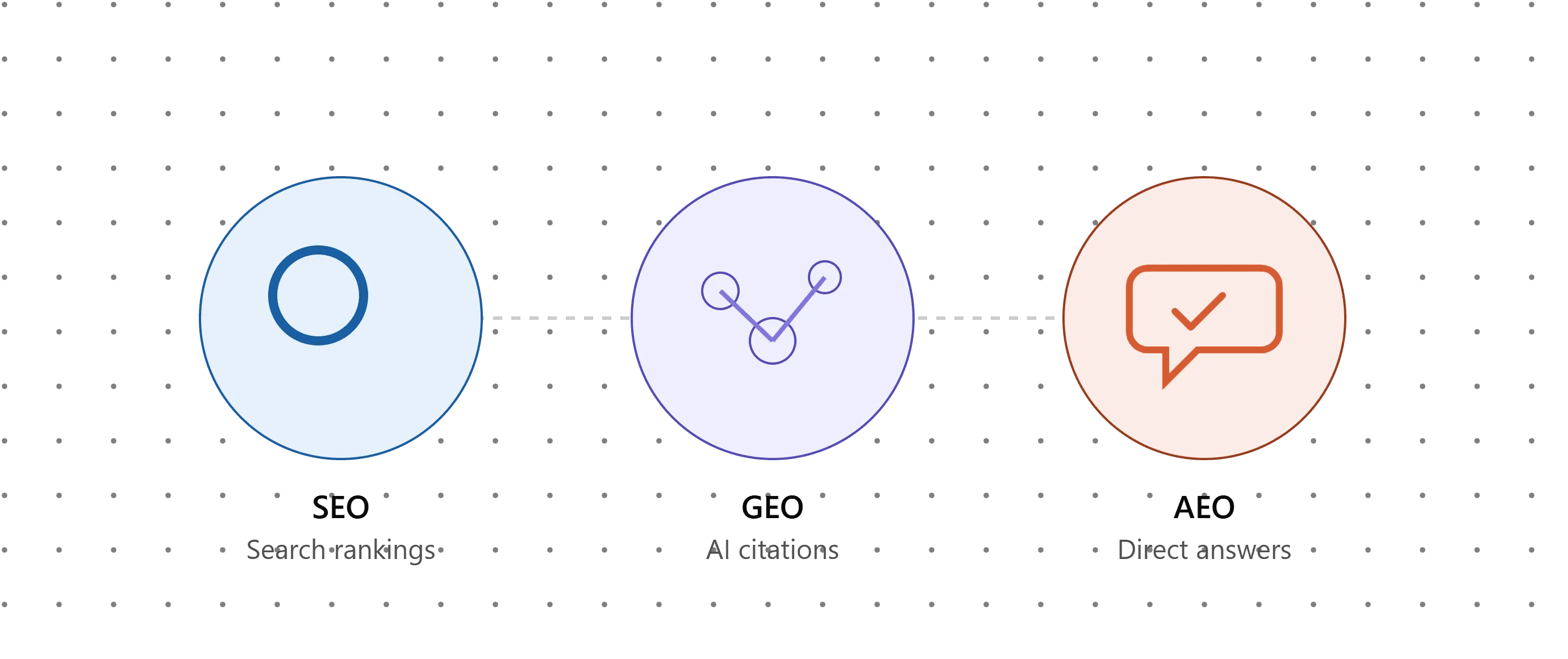
SEO, GEO, and AEO are three different games being played on the same search battlefield. SEO optimizes for ranking on traditional Search Engine Results Pages (SERPs) like Google, Microsoft Bing, Baidu, Yahoo!, and more. GEO optimizes for being cited inside AI-generated answers from tools like Gemini and SearchGPT, and AEO optimizes for winning the single direct answer voice assistants and AI Overviews read aloud or display first. In 2026, you don't pick one, you need all three working together, because the results page and AI's answer box are no longer the same destination.
Table of Contents
- SEO
- GEO
- AEO
- How SEO, GEO, and AEO Work
- SEO vs GEO vs AEO
- Future-Proofing Search Engine Visibility with DO Studio
- Frequently Asked Questions
- Conclusion
What is Search Engine Optimization?
SEO is the practice of ranking pages on traditional search engines like Google, Microsoft Bing, Baidu, Yahoo!... by optimizing technical performance, backlinks, and search intent.
It's still the foundation everything else sits on. In 2026, that means:
- Technical site performance: page speed, mobile responsiveness, clean site architecture, and crawlability. Bots can't rank what they can't efficiently read.
- High-quality backlink architecture: links from authoritative, topically relevant domains still signal trust to Google's ranking algorithms.
- Search intent targeting: matching content to what a searcher actually wants (informational, transactional, navigational) rather than just stuffing in keywords.
- Long-to-medium content depth: SEO still rewards comprehensive pages that fully answer a query, unlike the short, punchy formats AEO prefers.
The goal here is simple: rank pages, earn the click. SEO's traffic source is human searchers actively scrolling and choosing a blue link, which is exactly why it remains the backbone of organic discovery, even as AI answers eat into click volume.
What is Generative Engine Optimization?
GEO is the practice of structuring content with generative AI models, which powering Google AI Overviews, SearchGPT, and Perplexity to pull your brand and data into their synthesized answers.
This is fundamentally different from ranking a page. GEO optimizes for appearing inside an AI-written response, not for appearing as a link beneath it. That requires:
- Information density: packing verifiable facts, numbers, and clear entity relationships into tight paragraphs, since Retrieval-Augmented Generation (RAG) models retrieve and synthesize chunks of text, not full pages.
- Direct entity citations: clearly naming brands, people, places, and data points so entity resolution (the process by which an AI model matches a term to a known real-world entity) works in your favor.
- Statistical validation: citing real numbers, studies, or benchmarks, because generative models are trained to trust and surface content that reads as factually grounded rather than vague marketing copy.
- Brand trust and mention frequency: the more consistently your brand is mentioned across the web in factual, citation-worthy contexts, the more "trustworthy" an AI model treats it as a source.
GEO's core metric isn't rank, it's citation frequency inside AI-generated replies.
What is Answer Engine Optimization?
AEO is the practice of formatting content so AI assistants and answer engines like Alexa, Siri, Gemini's voice mode, featured snippets who can extract one clear, direct answer immediately.
Where GEO is about being one of several sources an AI synthesizes from, AEO is about becoming the answer. That means:
- Conversational search queries: writing for how people actually talk to voice assistants ("what's the best branding agency near me") rather than clipped keyword phrases ("branding agency Kerala").
- Direct short answers: a clean 1-3 sentence answer placed immediately under a header, built to be lifted verbatim.
- Structured schema markup: FAQ schema, HowTo schema, and Q&A formatting that explicitly tags content as an answerable unit for machines to parse.
- Short, scannable content blocks: AEO punishes long-winded intros; the answer needs to appear almost instantly.
How SEO, GEO, and AEO Work Behind the Scenes
The mechanics differ more than most people realize:
- Search engine bots vs. LLM web crawlers process data differently. Traditional Google bots crawl and index full pages for keyword and link relevance. LLM-based crawlers (used to train or ground generative models) chunk content into smaller retrievable segments, evaluating each chunk's factual density independently of the page it sits on.
- The shift is from exact keywords to user intent vectors. Older SEO matched literal keyword strings. Modern systems like both Google's and generative AI's who convert queries into user intent vectors, mathematical representations of meaning, not just words. This is why a page can rank or get cited without ever using the searcher's exact phrase.
- Structured data maps semantic connections between real-world entities. Schema markup, knowledge graphs, and consistent brand mentions across the web help engines link "your brand" to "branding agency," "Kerala," and "small business services" as connected entities, this is the backbone of both GEO and AEO visibility.
- Freshness and trust compound across all three. AI Overviews and RAG models weight recency and authority heavily; a page that's outdated or contradicted elsewhere on the web gets deprioritized fast, regardless of how well it once ranked.
SEO vs GEO vs AEO: Quick Comparison Table
| Feature | SEO | GEO | AEO |
|---|---|---|---|
| Primary Target | Google search rankings | AI-generated replies (Gemini, SearchGPT, Perplexity) | Voice assistants & AI Overviews |
| Core Optimization Metric | Rank position & click-through rate | Citation & mention frequency in AI answers | Direct answer capture |
| Key Strategy | Backlinks, technical SEO, keyword-intent match | Information density, entity citations, statistical proof | Schema markup, short direct answers, conversational phrasing |
| Primary User Intent | Search intent (browse, compare, decide) | Question intent (get a synthesized answer) | Voice & task intent (get one fast answer) |
| Result Type | Blue links | AI-written output | Read-aloud or one-clean-answer box |
| Content Length | Medium to long | Medium | Short and clear |
| Schema Use | Helpful | Very important | Must-have |
| Trust Factor | Links | Brand authority | Correct answers |
| 2026 Priority | Medium | Very high | High |
Real-World Blueprint: Future-Proofing Search Engine Visibility with DO Studio
DO Studio, a leading SEO Company in Calicut, working example of what it looks like to run SEO, GEO, and AEO as one connected system rather than three separate campaigns.
SEO Implementation: DO Studio builds the technical foundation first from clean, mobile-responsive site architecture, fast load speeds, and regional keyword structures tuned to how Kerala and Gulf-based customers actually search (city-specific terms, Malayalam-English mixed queries, local "near me" intent). This is the layer that still drives the bulk of organic click traffic.
AEO & GEO Adaptation: On top of that foundation, DO Studio structures content assets with clear entity-relation styling for connecting a client's brand name to its industry, location, and service category so AI models can resolve the entity correctly.
They back claims with factual source references and format key information as direct semantic answers placed immediately under headers, rather than burying them in long intros. For brands operating across both Kerala and the UAE, this dual structuring means the same content asset can rank on a traditional Google SERP and get pulled into a generative AI Overview or conversational answer are capturing visibility in both search realities at once, instead of optimizing for a world that no longer fully exists.
Frequently Asked Questions
- Can a business survive on traditional SEO alone without GEO?
For now, yes. SEO still drives the majority of click-based traffic in most industries. However, as more searchers get answers directly inside AI Overviews without clicking through, businesses relying on SEO alone will see visibility (and traffic) erode over time. GEO isn't a replacement. it's insurance against that shift. - What is the easiest way to optimize a website for AI Overviews?
Start by placing a direct, 2-3 sentence answer immediately under every major header on your key pages. But before any storytelling or context. Pair that with clear factual statements (numbers, names, locations) instead of vague marketing language, since AI models retrieve and cite specificity far more readily than generic claims. - Does schema markup matter for Generative Engine Optimization?
Yes, significantly. Schema doesn't just help traditional rich snippets, it gives generative models an explicit, machine-readable map of what your content is (a product, an FAQ, a how-to, a review), which speeds up entity resolution and increases the odds your structured facts get pulled into an AI-generated answer. - Is AEO the same as voice search optimization?
Mostly overlapping, but not identical. Voice search optimization is a subset of AEO focused specifically on spoken queries and audio read-back. AEO also covers text-based AI Overviews and chat-based answer engines where the "answer" is read on screen, not spoken aloud.
Conclusion
Treating SEO, GEO, and AEO as competing strategies is the fastest way to lose ground in 2026. They're not competitors, they're three layers of the same visibility stack. SEO earns you the click, GEO earns you the citation, and AEO earns you the direct answer. The businesses that win going forward are the ones structuring content once, well, so it performs across all three simultaneously.
Take a hard look at your current content: does it rank, does it get cited, and does it get read back as a direct answer? If you're only confident about one of those three, it's worth auditing your search strategy properly or talk to Do Studio. We are already building for all three at once.